| Source | https://www.youtube.com/watch?v=C85IT8gVTMI |
|---|---|
| Readwise URL | https://read.readwise.io/read/01kw1ez5hsr5t489rnx4xgbnkh |
| Readwise ID | 01kw1ez5hsr5t489rnx4xgbnkh |
| Author | Adam Lyttle |
| Category | video |
| Site | YouTube |
| Published | 2025-04-23 |
| Saved | 2026-06-26T07:58:03.832000+00:00 |
| Tags | adam-lyttle, app-development |
Readwise Summary: Adam Lyttle discovered a growth hack that helped his app reach number three in the App Store within three days by boosting download velocity. He says getting 20,000 downloads quickly, often through viral marketing and ads, can greatly improve app ranking. However, viral downloads may not generate high revenue, but they help increase keyword positioning fast.
I accidentally discovered a growth hack that got my app ranking number three within 3 days of launch. This is unheard of. This is something that I’ve never done before. It usually takes months to get this sort of traction on the app store, but day after day, my app increased in keyword ranking. And the way I did it was surprisingly simple. In this video, I’m going to show you the growth hack I accidentally stumbled across. And with any luck, you can do
it, too. This is one of those videos where I actually think this sort of insight should probably be kept a secret so I can keep the tip to myself and have a competitive advantage. Nah. When you launch your app, you do your keyword research. You do your keyword research, right? Right. For a few days, the app store gives you a boost. But if you check with a tool like Astro, you will notice the keywords are pretty much non-existent or your ranking is just
really poor. How are people finding your app? It’s not a mystery. It’s this recommendation search field here. For the first few days of launch, your app ranks in this drop-own list. I did a whole video on that because, of course, I did. Go check it out. After the boost disappears, you’re left in the wilderness alone amongst your competitor for months. With a trickle of downloads, you slowly increase your ranking by getting good reviews, having a good app store listing, all that kind of normal
stuff. Then, if you’ve played the game right, it just organically starts to rise after 6 months. To date, this has been the entire strategy for my app development portfolio. build an app, release it, and while I’m waiting for it to rank, I build another app, release it, and then monetize that original app. But I have a new strategy now, and this one takes advantage of download velocity. Download velocity is how many
downloads originated from external sources. You launch your app and you rely entirely on downloads from the app store. Your download velocity is low. That’s a sad looking download velocity. Cheer up there, champ. It gets better in 6 months time. Instead, you promote your app. Let your audience know it’s released. People check it out. Maybe out of curiosity. Maybe because they want to support you. Maybe just because the app is something that they actually want to
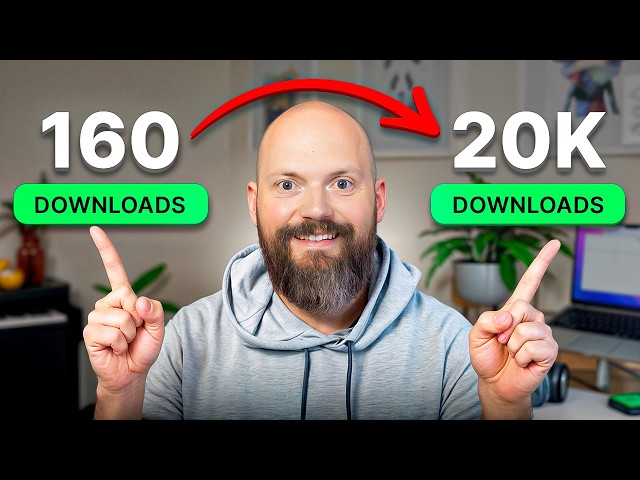
use. Now, you get a few extra downloads from external sources. Look at that download velocity. He looks so much happier now, doesn’t he? But how many downloads from external sources do you need to rank number three for a keyword with a difficulty of 57? 20,000. 20,000 is how many you need. There you go. Now you know the secret. Now go out there and accumulate 20,000 downloads to your app in the first 30 days of launch and thank me later. What’s that? It’s not
that easy. Seriously though, the only way I achieved this was by accidentally riding a viral trend and going viral with my app. Rankings went from a position of 191 on the first day to position three a few days later. So, how can we repeat that volume of downloads? We can’t just rely on a single tweet or an announcement on our socials. Chances are, it’s just not going to happen. Aim for virality with a solid strategy. I’ve
been absolutely obsessed with this form of distribution for the last few weeks. Can you tell? Viral traffic didn’t convert very well into revenue. In my case, I would usually expect revenue to be around about 50 cents to $1 per download when the user finds the app through the app store. But when my app got 20,000 downloads by going viral, I did the math in my head and I thought, I’m going to make like$10,000 $20,000 off this. I’m a genius. But the reality was very different. Viral distribution
revenue was around about 10 cents to 20 cents per user downloading. And I guess people coming from the app store already have their wallets open. Someone who sees an app in their feed just isn’t prepared to buy something in this moment. But the viral growth accelerated the download velocity and shot my app to number three for the targeted keyword. So, the objective may not be to convert viral users to paying customers, but instead to go viral to boost app store keyword positioning at launch. 20,000
downloads feels kind of achievable when you’re paying for user generated content, boosting Tik Tok posts, and running ads on Instagram. Basically, just throwing a massive budget at marketing when you launch your app for a solid 3 days. just empty the bank account on ads. What could go wrong? To reduce the risk of a flop, the app would need solid keyword research and the videos for the campaign produced would
have to be created before launching. And then when the app is released, fire off the campaign and watch the download saw. If you want to be paid to promote my apps in upcoming releases, check out the link in the description below and join my WAP program. Be sure to subscribe and check my progress on this because I’m going to be testing every part of